
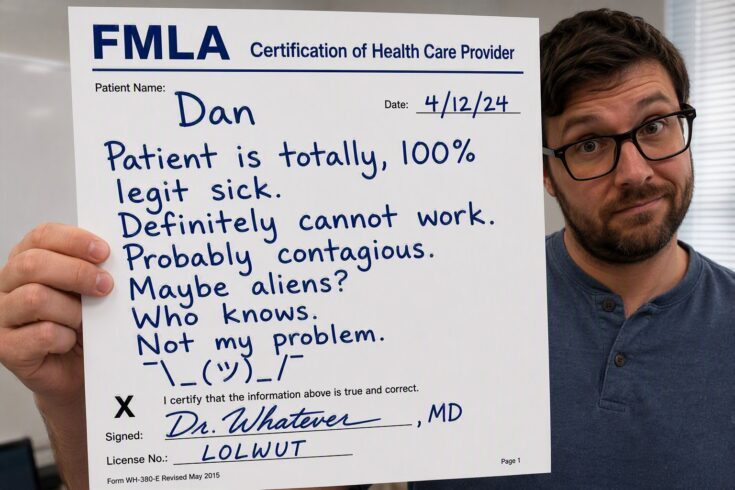
Imagine receiving an FMLA medical certification from your employee, Dan, that has his handwriting all over it except for the physician’s signature. Your fraud radar is screaming, so you want to confirm directly with his doctor whether this document is legit.
But before you can call his doctor to authenticate the document, imagine further that the law requires you first to allow Dan the opportunity to fix his certification and return a new or updated one to you.
That is what one court said.
Thankfully, this past week, another court put a stop to that kind of nonsense.
The Facts
In this story, Dan sought FMLA leave to care for his mom. As we know, FMLA medical certification includes a section specifically designated for the healthcare provider to complete. Rather than leaving that task to the medical professional, however, Dan filled out the provider section himself using information from a prior certification and his own knowledge of his mom’s condition. He then brought the form to a nurse, who signed it.
Later, concerns arose. The employer recognized what appeared to be Dan’s handwriting in the section to be completed by the physician. As a result, the employer contacted the provider’s office to determine whether the certification actually had been authorized. Turning the temp up, the nurse noted that he believed he was signing what amounted to a generic work excuse and did not realize he was certifying an FMLA leave request.
Shortly thereafter, Dan’s employment was terminated.
As these stories tend to go, Dan sued, claiming the employer interfered with his FMLA rights by contacting the provider before giving him an opportunity to “cure” the certification.
A creative argument, and funny enough, Dan convinced the trial court that his was the better position. Under the trial court’s reasoning, the employer had to first give the employee seven days to cure the suspected fraudulent certification before reaching out to the physician to authenticate it. Apparently, the trial court treated a potential authenticity problem as a “deficiency” that triggered the FMLA’s “cure” process.
Let’s pause here.
Because under this interpretation, the conversation between Dan and his employer would go something like this:
Danny boy, we believe this certification may be fraudulent. It looks as though you filled out the provider section yourself, and we have reason to believe the nurse may not have known what he was signing. But before we can contact your doctor to determine whether the certification is the real deal, we first have to give you seven days to take the form back and fix the problem.
Then, after you’ve had the opportunity to revise the paperwork and speak with your doc, we’ll circle back and investigate whether the original certification was fraudulent.
Sounds ridiculous, right?
By the time the employer gets around to authenticating the original certification, Dan already has had ample opportunity to smooth over any inconsistencies, obtain a replacement certification, or otherwise eliminate the very evidence the employer sought to verify in the first place.
Thankfully, the appellate court wasn’t buying it.
The Appellate Court: Let’s Go Back to the Basics
In an admittedly not-so-fun read, the appellate court decision does plenty of dense, regulatory navel-gazing, so it’s not a model of clarity for those of us who like plain English. That said, the court finally got to the heart of the matter: the FMLA’s cure process is designed for certifications that are incomplete, vague, or missing information, not certifications that an employer suspects were conjured up by the employee himself.
The court pointed out that the regulations talk about “deficiencies” and “authentication” as separate concepts, dictionaries don’t typically define “fraud” as a paperwork deficiency, and the Department of Labor long ago eased restrictions on employer authentication efforts. That’s an important distinction. An employer investigating authenticity isn’t asking for more information. It’s asking whether the information already provided is genuine. In other words, the regulations don’t require an employer to announce, “We think you submitted a fraudulent certification, so we’ll give you seven days to tidy things up before we check whether it’s fraudulent.”
Read the court decision here: Mook v. City of Martinsville (pdf)
Insights for Employers
This appellate court decision certainly takes the blood pressure down, as the trial court’s decision had us leave of absence nerds here at Littler agonizing a bit over how we counsel clients on a court decision that flat out swung and missed on its reading of the FMLA regs.
What are the takeaways from this (correct) decision?
1. Don’t confuse a deficient certification with a potentially fraudulent one.
Naturally, the FMLA regulations require you to give employees an opportunity to cure certifications that are incomplete, vague, ambiguous, or otherwise insufficient. That’s very different from a situation where you have reason to believe the certification was never properly authorized by the healthcare provider in the first place. As Dan’s case illustrates, authenticity concerns are a separate animal altogether.
2. Authentication remains an underutilized anti-fraud tool available to employers.
Many employers are so concerned about running afoul of the FMLA or HIPAA that they never utilize the authentication process. That’s a mistake. First off, remember that HIPAA does not apply to this FMLA situation, as employers have the right to know (within the parameters of the regulations) basic information about the employee’s serious health condition and why they can’t come to work. When this process is handled properly, authentication allows an employer to ask a simple line of questioning, specifically: “Did you complete or authorize this certification?” In the right case, that single question can tell you everything you need to know.
3. Document why your suspicions were raised.
Cases involving suspected fraud are rarely won because an employer had a “gut feeling.” They’re won because the employer can identify objective facts that triggered concern. Here, the employer had information suggesting the employee completed the provider portion of the form himself and that the nurse may not have understood what he was signing. Employers should similarly be prepared to articulate the facts that led them to seek authentication.
4. Be careful not to turn an authentication into an interrogation.
Remember that authentication has limits. The purpose is to verify whether the provider completed or authorized the certification. It is not an opportunity to seek additional medical information, discuss the employee’s diagnosis, or conduct a fishing expedition. Stay in your lane.
5. If something smells fishy, don’t wait too long to investigate it.
One of the more troubling implications of the trial court’s decision was that it would have forced employers to essentially announce their fraud concerns and then wait around while the employee attempted to “cure” the problem. The Appellate Court wisely rejected that approach. When there is a legitimate question about whether a certification is authentic, employers should promptly — and timely — evaluate whether authentication is appropriate rather than allowing potential problems to fester.
Hat tip: Thanks to my Littler colleague, Mark Phillis, for alerting me to this court decision and putting my mind a bit more . . . at ease.