
If you have loved ones who depend on you for financial support, purchasing or enrolling in the right insurance coverage can provide crucial security and peace of mind.
Traditionally, life insurance policies have been the coverage of choice. However, accidental death and dismemberment (AD&D) insurance is another option that offers some similar benefits while coming with its own advantages and disadvantages.
Would it benefit you to have both options? While there is some overlap in coverage, life insurance and AD&D insurance are each designed to pay out different types of claims. The combination of coverage that’s right for you depends on many things, including your lifestyle and the needs of your beneficiaries.
Bryant Legal Group has represented the best interests of many Illinois clients facing denials and pushbacks on their insurance coverage. Our goal is to help our clients navigate complications of the system, argue against challenges, and receive the coverage they deserve.
What Types of Life Insurance Are Available?
Life insurance pays out benefits to your family members or other specified beneficiaries in the event of your death. Although the overall options of any individual policy may differ, general forms include term, permanent, and universal.
Term Life Insurance
Term life insurance provides coverage for a certain period. If you get life insurance through your employer, the “term” is simply the duration of your employment. If you purchase your own plan independently, term lengths of 10 to 30 years are common.
Whichever term you choose for this form of insurance, the death benefit is only paid out while the policy is in effect. If you outlive your policy, you receive no benefit.
Some of the most frequent providers of term life insurance in Illinois are State Farm, Banner Life, and Northwestern Mutual.
Permanent Life Insurance
Sometimes called whole life insurance, permanent life insurance provides coverage for as long as you live. In addition to paying a death benefit when you pass away, a portion of your premiums is saved and used to gradually build cash value that you can access and use during your lifetime.
While this setup can provide a nice “extra” source of savings and income in retirement, it also comes at a cost. Permanent life insurance plans are more expensive, and cash value may not necessarily build as quickly as other types of investments.
Some of the most frequent providers of permanent life insurance in Illinois are Northwestern Mutual, New York Life, and MassMutual.
Universal Life Insurance
Universal life insurance is a specific form of permanent life insurance. It also accumulates cash value, but the policyholder can often adjust their premium payments and death benefit over time.
However, the flexibility offered by universal life insurance may come with added complexity to the overall terms of the policy. Insurers may take advantage of this complexity when challenging or denying your claim.
Some of the most frequent providers of universal life insurance are National Life Group, Transamerica, and Mutual of Omaha.
When to Consider Life Insurance
Most American families with at least one working-age adult depend on one or more full-time salaries to afford their desired standard of living.
If your family would struggle to pay bills or maintain a high quality of life without your salary, purchasing a regular life insurance policy makes a great deal of sense. While nothing could ever truly replace the loss of a loved one, life insurance provides peace of mind with the knowledge that your loved ones will still have a means of financial support after you die.
While the majority of deaths will be covered, it is important to note that many life insurance policies come with some exclusions. For example, your policy might exclude specific illnesses, risky activities, or suicide.
Some exclusions, such as fraud, will apply over the lifetime of the contract while others might only be in force during the “contestability period”—usually the first two years after purchasing your policy. Individual policy language can vary, so it is important to carefully review your policy.
How Much Life Insurance Do I Need?
Many employees are offered a life insurance policy at no cost from their employer. However, often these policies only offer limited coverage that would pay end-of-life expenses (such as funeral costs) but not provide longer-term financial security for surviving family members.
Limits for employer-provided life insurance are often $50,000, since this is the maximum amount that can be provided tax-free by an employer with at least 10 employees. If the employee wants more coverage, they must purchase it themselves.
A good baseline is to start with about 10 times your annual salary in coverage. However, this alone will not be enough for everyone. You should consider how your family’s financial obligations are likely to change over the term of the policy and adjust accordingly. For example, if you are planning to have more children or your spouse would need to hire childcare or household services if you pass away, you might need more than 10 times your salary.
RELATED: What Happens to Your Employer-Sponsored Insurance When Your Employment Changes?
Should I Take Out Life, Permanent, or Universal Life Insurance?
There are pros and cons to each.
Term life makes sense if you already have a solid retirement plan and only need coverage during the period when you have significant financial obligations—for example, while you still have children in the house, or until retirement.
Permanent life insurance, meanwhile, might be considered in certain circumstances if you can afford the premiums and expect to have lifelong financial commitments (such as caring for a disabled family member or paying significant estate taxes after death) or want to set up a trust or inheritance. Speaking with a financial planner can help you weigh your options.
When it comes to universal life insurance, there is potential for higher returns than one might have for standard permanent life insurance. However, it comes with more complexity and a need for careful management. If the cash value of the policy isn’t enough to cover ongoing costs, the policy could end even after years of payments.
RELATED: On What Basis are Life Insurance Claims Typically Denied?
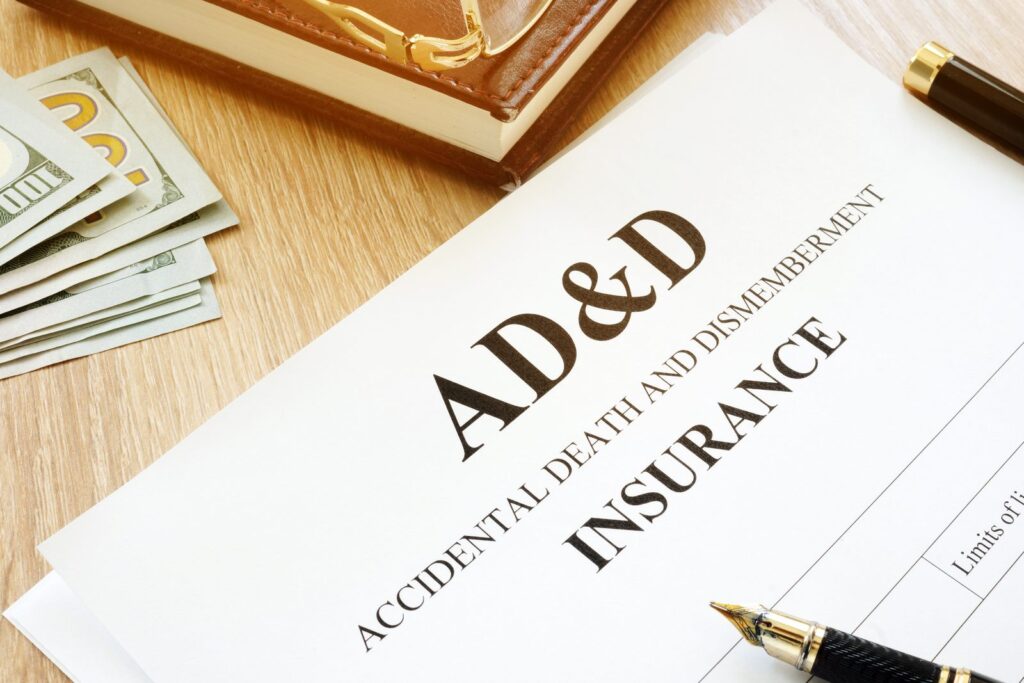
What Is AD&D Insurance?
As the name suggests, accidental death and dismemberment, or AD&D, is an insurance policy that covers you in the case of a qualifying accidental death or certain accidental injuries.
Accidental death coverage means that the policy pays out a death benefit if you die in an unexpected, non-natural event such as a car accident, drowning, or homicide.
Dismemberment coverage means that your policy will pay out a portion of the death benefit if the accident does not kill you but results in the loss of a body part or major body function. For the purposes of an AD&D claim, dismemberment may mean loss of a limb, loss of a major sense such as hearing or eyesight, or even paralysis.
AD&D is usually not offered as a standalone insurance policy but as a rider to either a life insurance or health insurance plan. If your employer offers benefits, AD&D may be an item you can opt into during your benefits enrollment period. You can also purchase it as an addition to an independent life insurance policy.
If you have an AD&D rider on your life insurance policy then die in an accident, your beneficiaries will typically receive a payout both from the accidental death insurance as well as the regular life insurance.
AD&D Doesn’t Cover Every Death and Dismemberment
While AD&D insurance is often significantly cheaper than a traditional life insurance policy, it also comes with significant limitations and exclusions.
AD&D will only pay out if your death or injury is the result of an accident. Other kinds of death or dismemberment will not result in benefits. It is estimated that natural causes account for more than 9 in 10 deaths, and AD&D insurance will never cover these deaths. Many people who purchase AD&D insurance will never receive any benefit from it.
Insurance Companies Decide What “Accidental” Death Means
The definition of “accidental” death is subjective, and eligibility for benefits frequently hinges on not only the facts of the case but also the specific language used in your policy. AD&D policies often include an extensive list of exclusions, including death or dismemberment by:
- Illness, including mental illness
- Suicide
- Acts of war
- Drug overdoses
- Driving under the influence of drugs and alcohol
- Non-commercial aviation
- Participation in criminal activity
- High-risk recreational activities, such as skydiving
While some of these exclusions might also apply to your regular life insurance policy, AD&D policies tend to be much stricter about what is and is not a covered accident. It is common for beneficiaries to wait a long time before the insurance company makes a ruling on whether their family member’s death or dismemberment resulted from a qualifying accident. In some cases, forensic investigation or even an autopsy must be performed.
Do I Need AD&D Insurance?
AD&D insurance should never be considered as a substitute or alternative to life insurance. Most people do not die of accidental causes or suffer dismembering injuries. Even those who die unexpectedly often do so for natural causes like stroke or heart attack, and AD&D will not apply. So, relying on AD&D alone to provide for your family is unwise.
That said, some people might consider AD&D as a supplement to a robust life insurance policy under certain circumstances. These might include:
- People who work in dangerous occupations such as construction workers or truck drivers
- People with occupations that have high risk of non-fatal, life-altering injuries such as roofing or meat packing
- Anyone with AD&D coverage and premiums provided at no or very low cost by their employer
The primary advantage to AD&D over life insurance alone is that life insurance will not pay anything for severe or disabling injuries, while AD&D will. Losing limbs or eyesight, for example, can have just as severe of a financial impact on your family as your death would. And unlike workers’ compensation, AD&D can cover injuries that occur both in and out of the workplace.
But in general, you should view AD&D as a supplemental option that provides added protection. It should not be used as a replacement for life, workers’ compensation, or disability insurance.
Life insurance Vs. Accidental Death and Dismemberment: What’s Covered by Each?
Below is a side-by-side comparison of the types of claims which life insurance and AD&D insurance each cover. Please note that these are general examples. Coverage of claims will always depend on the policy itself, as well as the circumstances of the claim.
| Claim | Life Insurance | Accidental Death & Dismemberment |
| Death by illness | Covered | Not covered |
| Death by suicide | Usually covered, with some exceptions | Not covered |
| Death from an accident (vehicle collision, drowning, workplace accident, etc.) | Covered | Covered |
| Dismemberment/loss of limb/blindness/deafness not resulting in death | Not covered | Covered |
| Death via high-risk recreational activities (skydiving, extreme sports, etc.) | Usually covered, but at higher premiums | Not covered |
| Homicide | Covered | Covered |
| Death while perpetrating a crime | Not covered | Not covered |

Dealing With an Unfair Insurance Denial? Call Bryant Legal Group Today
Both life insurance and AD&D are supposed to give policyholders peace of mind. If the unthinkable happens, you want to know that your loved ones will have the means to support themselves.
Beneficiaries often struggle to get the benefits they paid for. Insurance companies frequently dispute legitimate claims by saying they are not covered by the policy. When this happens, it is important to speak with an expert who can help you understand what is covered under your policy and fight back on your behalf if you are dealing with an unjustified coverage denial.
Bryant Legal Group is Chicago’s premier insurance litigation law firm. Our attorneys have extensive experience advising and representing policyholders in life and AD&D insurance disputes. We work exclusively on behalf of those who receive benefits—never insurance companies.
To schedule your free consultation with one of our Chicago insurance attorneys, call us or complete our online form today.