
Illinois’ texting and driving law is broader than its name suggests: 625 ILCS 5/12-610.2 bans nearly all handheld electronic device use behind the wheel, not just texting, with fines running from $75 for a first offense up to a $1,000 minimum if device use causes a serious injury or death.
What the Law Actually Prohibits
Illinois’ electronic communication device law, 625 ILCS 5/12-610.2, covers more than texting. It prohibits handheld phone calls, texting, web browsing, email, and app use while driving. Illinois moved years ago from a texting-only ban to this broader handheld restriction, so “hands-free” is the operative standard, not just “no texting.”
Current Penalties
As of this writing, the fines are: up to $75 for a first offense, $100 for a second, $125 for a third, and $150 for a fourth or subsequent offense. A separate, more serious provision applies when device use causes a crash resulting in serious injury or death, carrying a minimum fine of $1,000. Note: a bill introduced in the Illinois legislature in January 2026 would raise these fines significantly, but as of publication it has not been enacted, the figures above reflect current law.
How Common Are These Crashes?
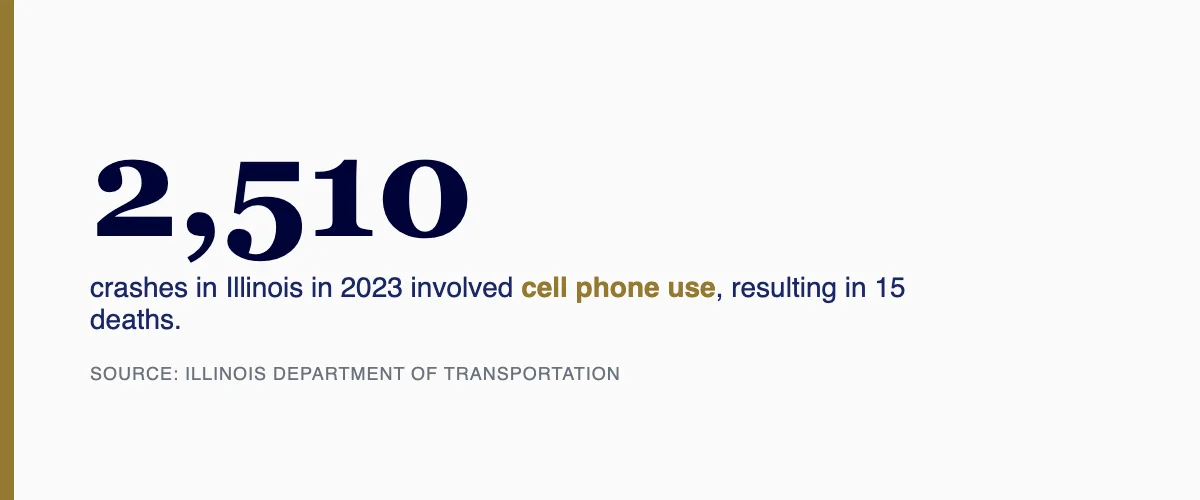
According to the Illinois Department of Transportation, 2,510 crashes in Illinois in 2023 involved cell phone use, resulting in 15 deaths and 1,013 injuries. Looking at distracted driving more broadly, 51 people were killed in distraction-involved crashes in Illinois in 2024, about 4.3% of all traffic fatalities that year, and 253 people were killed with 28,271 injured in distraction-involved crashes between 2020 and 2024.
Can Police or Insurers Actually Prove You Were Texting?
Proving device use at the moment of a crash usually comes from a combination of sources. A witness or the other driver may report seeing a phone in hand. An officer may note phone use in the crash report based on what they observed or what a driver admitted at the scene. Beyond that, a driver’s own cell carrier records can show the exact time of a call, text, or data activity, which can then be matched against the time of the crash. In a disputed case, an attorney can subpoena these records as part of the discovery process described in our guide on how discovery works in a Chicago personal injury claim. None of this is automatic, it typically requires requesting the right records early, before they’re no longer readily available.
How a Texting Citation or Phone Records Affect a Civil Claim
Beyond the traffic fine itself, a device-use citation or a driver’s own phone records can become important evidence in a car accident claim. Records showing a call, text, or app activity at the time of the crash can directly support a negligence claim by establishing the other driver was distracted. Our guide on evidence you need after a car crash covers how this kind of evidence fits into building a claim.
Texting Is One Form of Distracted Driving
Handheld device use is just one category of distracted driving. For a broader look at how Illinois law treats distraction generally, including eating, grooming, and other distractions beyond phone use, see our guide on the types of distracted driving.
Frequently Asked Questions
What does Illinois’ texting and driving law actually cover?
Illinois’ electronic communication device law, 625 ILCS 5/12-610.2, bans more than just texting, it prohibits handheld calls, texting, web browsing, email, and app use while driving. It’s a broader handheld-device ban, not a texting-only law.
What are the current fines for texting and driving in Illinois?
As of this writing, fines are up to $75 for a first offense, $100 for a second, $125 for a third, and $150 for a fourth or subsequent offense. A separate provision carries a minimum $1,000 fine if device use causes a crash resulting in serious injury or death.
Can phone records be used as evidence in a car accident claim?
Yes. Cell phone records and, where applicable, a texting or device-use citation can support a negligence claim by showing a driver was distracted at the time of the crash.
How common are texting-related crashes in Illinois?
According to IDOT, 2,510 crashes in Illinois in 2023 involved cell phone use, resulting in 15 deaths and 1,013 injuries. More broadly, 51 people were killed in distraction-involved crashes in Illinois in 2024, about 4.3% of all traffic fatalities that year.
Also Read:
What Are the 3 Types of Distracted Driving?
Evidence You Need After a Car Crash in Chicago
{“@context”:”https://schema.org”,”@type”:”FAQPage”,”mainEntity”:[{“@type”:”Question”,”name”:”What does Illinois’ texting and driving law actually cover?”,”acceptedAnswer”:{“@type”:”Answer”,”text”:”Illinois’ electronic communication device law, 625 ILCS 5/12-610.2, bans more than just texting, it prohibits handheld calls, texting, web browsing, email, and app use while driving. It’s a broader handheld-device ban, not a texting-only law.”}},{“@type”:”Question”,”name”:”What are the current fines for texting and driving in Illinois?”,”acceptedAnswer”:{“@type”:”Answer”,”text”:”As of this writing, fines are up to $75 for a first offense, $100 for a second, $125 for a third, and $150 for a fourth or subsequent offense. A separate provision carries a minimum $1,000 fine if device use causes a crash resulting in serious injury or death.”}},{“@type”:”Question”,”name”:”Can phone records be used as evidence in a car accident claim?”,”acceptedAnswer”:{“@type”:”Answer”,”text”:”Yes. Cell phone records and, where applicable, a texting or device-use citation can support a negligence claim by showing a driver was distracted at the time of the crash.”}},{“@type”:”Question”,”name”:”How common are texting-related crashes in Illinois?”,”acceptedAnswer”:{“@type”:”Answer”,”text”:”According to IDOT, 2,510 crashes in Illinois in 2023 involved cell phone use, resulting in 15 deaths and 1,013 injuries. More broadly, 51 people were killed in distraction-involved crashes in Illinois in 2024, about 4.3% of all traffic fatalities that year.”}}]}
The post Texting and Driving Laws in Illinois: Penalties and Your Injury Claim appeared first on Phillips Law Offices.