Leahy Tax Blog
Blog Authors
Latest from Leahy Tax Blog
Earlier this week, Lake County Judge Luis A. Berrones ruled that the name of Lake County Board candidate Juan Beto Ruiz (Reynoso) should not be on the ballot. The Lake County Clerk has already printed ballots with the name of candidate Ruiz on them. Ruiz is challenging incumbent Esiah Campos; and his name has been printed as Juan Beto Ruiz. But his full legal name is Juan Beto Ruiz Reynoso. Unless Ruiz appeals, any ballots cast for him will not be counted.
Under the Illinois Election Code, candidates may use given names, initials, or commonly known nicknames when filing nomination

When Is a State-Created Entity an “Arm of the State” for Sovereign Immunity?
By Jake Leahy
Earlier this week, the U.S. Supreme Court clarified an important question in sovereign immunity law: when does a state-created entity qualify as an “arm of the State” entitled to share the State’s immunity from suit? In a unanimous 9–0 decision authored by Justice Sotomayor, the Court held that the New Jersey Transit Corporation is not an arm of the State of New Jersey and therefore cannot invoke the State’s sovereign immunity in out-of-state lawsuits. Galette v. New Jersey Transit Corp.
The case arose from two accidents involving New Jersey Transit buses: one happened in New York City, and the
…
Continue Reading When Is a State-Created Entity an “Arm of the State” for Sovereign Immunity?
Illinois Appellate Court Affirms Ballot Removal of Gubernatorial Candidates for Falling Short of 5,000 Signatures
By Jake Leahy
The First District Appellate Court has confirmed the removal of Joseph “Joe” Severino and Rantch Isquith from the March 17, 2026 Republican primary ballot for Governor and Lieutenant Governor after they failed to meet the 5,000-signature requirement for statewide candidates. Severino v. Illinois State Board of Elections, 2026 IL App (1st) 260151-U (Feb. 20, 2026). While the case is not groundbreaking, it is instructive to future candidates.
The candidates filed nomination papers containing 6,336 signatures. An objector challenged 2,520 of them. After a records examination, the State Officers Electoral Board sustained objections to 1,588 signatures, leaving the candidates with
When Can a Defendant Immediately Appeal a Denied Defense in Federal Court?
By Jake Leahy
Yesterday the Supreme Court decided GEO Group, Inc. v. Menocal, 607 U.S. ___ (2026), holding that the federal contractor doctrine recognized in Yearsley v. W.A. Ross Construction Co., 309 U.S. 18 (1940), is a merits defense rather than an immunity from suit. Because it is a defense to liability and not a right to avoid litigation altogether, a district court’s rejection of the defense cannot be immediately appealed under the collateral-order doctrine.
The decision is nominally about government contractors. Its real significance is about appellate timing and litigation leverage. The Court sharpened the line between arguments that defeat
…
Continue Reading When Can a Defendant Immediately Appeal a Denied Defense in Federal Court?
FEC Complaint Alleges Use of Nonfederal Funds in Illinois 9th District Congressional Race
By Jake Leahy
A complaint filed February 24, 2026, with the Federal Election Commission alleges that Daniel Biss, his principal campaign committee (Biss for Congress), and his state committee (Friends of Daniel Biss) violated the Federal Election Campaign Act by using nonfederal funds in connection with a federal election. See Complaint, Fine v. Biss, FEC Complaint (Feb. 24, 2026).
The complainant, Carol Ronen, asserts that Biss is simultaneously a candidate for U.S. House in Illinois’s 9th Congressional District and for Democratic State Central Committeeman. According to the complaint, Friends of Daniel Biss, which is rasiing money for the state central committee race
Supreme Court Holds President Lacks Tariff Authority Under IEEPA: A Reaffirmation of Congress’s Article I Taxing Power
By Jake Leahy
In Learning Resources v. Trump, the Supreme Court held that the International Emergency Economic Powers Act (IEEPA) does not authorize the President to impose tariffs. The Court treated tariffs as what the Constitution calls them: “Duties” or “Imposts,” falling within Congress’s Article I power to “lay and collect Taxes.” Because taxation is a core legislative function, the Court required clear congressional authorization before concluding that Congress transferred that authority to the Executive. General language allowing the President to “regulate … importation” was not enough to sustain sweeping, revenue-generating duties imposed under a declared national emergency.
The decision has broader
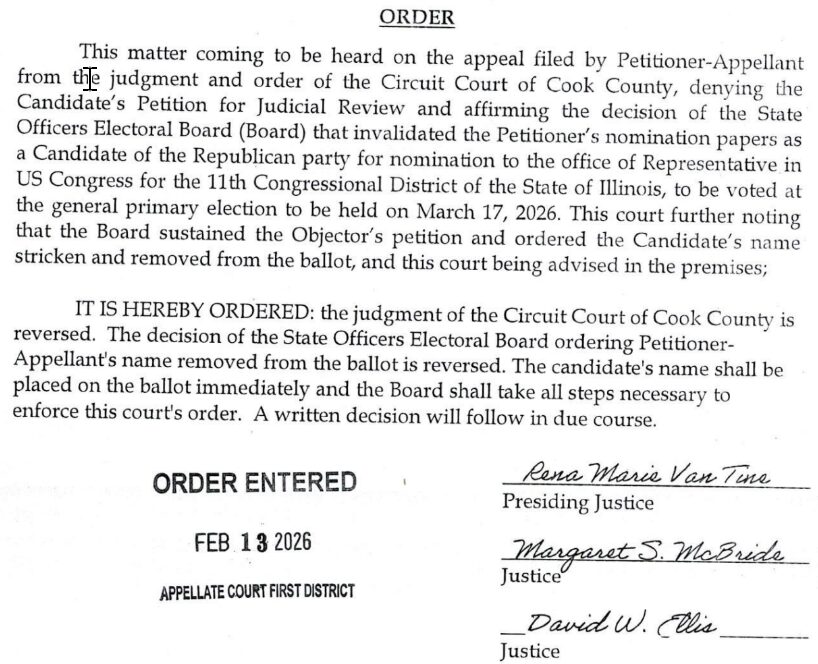
Illinois Ballot Removal and Judicial Review: Appellate Court Reverses Electoral Board Decision
By Jake Leahy
When a candidate is removed from the ballot in Illinois, the path forward runs through the courts.
Tedora Brown, a Republican candidate for Congress in Illinois’s 11th Congressional District, was removed from the March 17, 2026 primary ballot after the State Officers Electoral Board determined she had filed 798 valid signatures: one short of the 799 required under Section 7-10(b) of the Illinois Election Code.
She sought judicial review under Section 10-10.1(a) (10 ILCS 5/10-10.1(a)) in the Circuit Court of Cook County. The Circuit Court affirmed the Board. The Illinois Appellate Court later reversed in a one-page order that did
Chicago Sports Betting Tax Lawsuit: Can the City Balance Its Budget by Taxing Online Wagering?
By Jake Leahy
Facing a year-end deadline, the City of Chicago was able to get a budget passed that included some “alternative” revenue methods. In an effort to raise revenue, the City budget included new dollars from sports gambling.
Chicago adopted a new municipal licensing requirement and a 10.25% tax on certain sports wagering revenue as part of its year-end 2025 budget. The measure took effect January 1, 2026. Within days, a trade association representing major online sportsbook operators filed suit in the Chancery Division of the Circuit Court of Cook County. The case is Sports Betting Alliance v. City of Chicago,
A Quick Recap of Last Week’s Supreme Court Opinions
By Jake Leahy
Striking workers who do not take reasonable precautions to protect against property damage are not protected by the National Labor Relations Act, because this is a well-established carve-out, the state tort law claims are not preempted by the NLRA.
To bring a claim under Section 11 of the Securities Act of 1933, the plaintiff must prove they purchased securities traceable to an allegedly misleading registration statement.
The False Claims Act allows for relief against a person who “knowingly” submits
…
Continue Reading A Quick Recap of Last Week’s Supreme Court Opinions
A Review of Last Week’s Opinions
By Jake Leahy
Calcutt v. FDIC (Administrative)
Listen to the Calcutt v. FDIC Decision Syllabus here.
A banker was suspended and fined by the FDIC for actions he took on one financially troubled account. The Supreme Court reversed the Sixth Circuit, reasoning that the Court of Appeals must reverse the administrative agency if it reaches the same outcome for a different reason. Once an administrative agency has made an error of law, the decision must be remanded back to the administrative agency.
Tyler v. Hennepin County (Takings Clause)
Last Week’s Supreme Court Decisions
By Jake Leahy
The Supreme Court released several new decisions at the end of last week. While the most covered decision was probably where the Court ruled in favor of the photographer and against Andy Warhol, each decision offers a potentially helpful insight into the interworking of the Court.
Gonzalez v. Google LLC (Anti-Terrorism Act / Section 230)
Listen to the Supreme Court’s opinion syllabus here. After the Twitter ruling below, the plaintiffs failed to state a claim under the Anti-Terrorism Act. 18 U.S.C. §2333(d). The Court reversed and remanded and decided it did not need to reach the question regarding 47 U.S.C.
A Brief Summary of the Five Supreme Court Opinions Released on May 11
By Jake Leahy
The Supreme Court has been unusually slow this term, with fewer rulings compared to past years. However, the pace seems to be accelerating, with 19 opinions released recently, including five last Friday. Major rulings are anticipated in the coming months as numerous cases remain pending. Let’s briefly examine the cases from last Friday.
In this case, the Supreme Court ruled that the right-to-control theory for wire fraud, which has long been recognized in the Second Circuit, cannot be used to convict persons under federal fraud statutes. In this case, Ciminelli was convicted for wire fraud
…
Continue Reading A Brief Summary of the Five Supreme Court Opinions Released on May 11
Federal Jurisdiction Barred: Tax Injunction Act Precludes Federal Court for Interest-Only State Tax Case (DeMartino v. New York, 2nd Cir.)
By Jake Leahy
I had the chance to attend this oral argument at the Second Circuit Court of Appeals in the beginning of March. I had an open morning so I went to the court to see oral arguments, I didn’t have the chance to look at the cases beforehand, but to my surprise there was a Tax Injunction Act / SALT case being heard.
There was a group of about 20-30 high school students next to me attending the oral argument. There was another case that involved an employment discrimination suit brought by a Hispanic police officer, perhaps the high school students
A Brief Review of April 2023 Illinois Supreme Court Opinions
By Jake Leahy
Illinois Supreme Court Opinion Summary: PEOPLE OF THE STATE OF ILLINOIS v. DION ADDISON
The Illinois Supreme Court only issued on written opinion in the month of April. In Justice Rochford’s opinion, she sided with the defendant Dion Addison. While the bounds of the right to effective of assistance of trial counsel has been well-litigated, the question of effective assistance of appellate counsel, arising from the failure to properly plead ineffective assistance of appellate counsel, presents a slightly different question.
In this case, the Illinois Supreme Court addressed whether postconviction counsel provided unreasonable assistance by failing to frame the issues
…
Continue Reading A Brief Review of April 2023 Illinois Supreme Court Opinions
Seventh Circuit Affirms Decision Below in Favor of Blackstone in Ancestry Privacy Case
By Jake Leahy
In Bridges and Cunningham v. Blackstone, Inc., the Seventh Circuit of the United States Court of Appeals recently issued a ruling in favor of Blackstone, the defendant-appellee. Plaintiffs Carolyn Bridges and Raymond Cunningham filed a class action against Blackstone, alleging that the firm violated the Genetic Information Privacy Act (GIPA) in its acquisition of Ancentry.com.
Background
The plaintiffs submitted their DNA samples for genetic review years earlier to Ancestry.com. The plaintiffs allege that in Blackstone’s acquisition of Ancestry.com, it violated GIPA, which prohibits the disclosure of the identity of any person upon whom a genetic test is performed, or the
Tacking Doctrine, “Apple Music,” “Apple Jazz,” and a 1968 Beatles Trademark. Federal Circuit Rules Against Apple in Trademark Priority Case
By Jake Leahy
In a recent case before the United States Court of Appeals for the Federal Circuit, the court reversed the tribunal which it dismissed a case that sought to challenge Apple’s use of the mark “Apple Music” as applied to live musical events. Apple previously purchased a trademark that had originally been owned by the Beatles which had been used to cover certain products including live events. In using this mark, Apple attempted to “tack” its date back to 1968. The Federal Circuit found that while tacking was proper sofar as