A recent decision by the Massachusetts Supreme Judicial Court has sparked interest across legal circles. In a case centered around a $70,000 engagement ring, the court ruled that an engagement ring must be returned to the purchaser if the marriage does not take place, regardless of who may have been at fault. This ruling aligns Massachusetts with the majority of jurisdictions, where an engagement ring is considered a conditional gift—given with the expectation of marriage and thus, contingent upon the marriage actually happening.
While Illinois follows similar principles, this ruling offers a chance to examine how Illinois contract
Continue Reading Engagement Ring – Gift or Contract?
Bellas & Wachowski, Attorneys at Law
George Bellas started what is now Bellas & Wachowski Attorneys at Law after leaving his position as a prosecuting attorney in 1973. The firm consists of six attorneys and six support team members working in areas such as business law, business litigation and personal injury claims. Our law offices are located in the Chicago area, near O'Hare Airport and easy for our clients to reach from anywhere in the Chicago area.
Latest from Bellas & Wachowski, Attorneys at Law - Page 3
REMINDER! Mandatory Reporting Deadline under the Corporate Transparency Act
This is big reminder for every small business owner.
Under U.S. Corporate Transparency Act (CTA), most corporations, limited liabilty companies and other legal entities, including homeowners’ associations (HOAs), condominium associations, and co-op associations, are required to file Beneficial Ownership Information (BOI) with the U.S. Financial Crimes Enforcement Network (FinCEN) by no later than January 1, 2025. Every U.S. business must register and file this report.
Continue Reading REMINDER! Mandatory Reporting Deadline under the Corporate Transparency Act
Consumer Privacy Laws Include Neural Data: What Illinois Business Owners Need to Know
California enacted an Amendment to the California Consumer Privacy Act (CCPA) that adds neural data to the list of protected personal sensitive information. For Illinois business owners—especially those conducting business in California or utilizing neurotechnology—this development is worth understanding, as it marks another step in the expanding landscape of data privacy laws. Neural data, often collected through non-invasive neurotechnology tools, is now considered sensitive and will be protected under the same stringent requirements as other personal information like genetic, biometric, and geolocation data.
What is Neural Data and Why is it
Continue Reading Consumer Privacy Laws Include Neural Data: What Illinois Business Owners Need to Know
Insurance Coverage for BIPA Violations: A Growing Challenge for Illinois Businesses
Businesses across Illinois are facing serious challenges in securing insurance coverage for lawsuits brought under the Biometric Information Privacy Act (BIPA). And a recent decision by the federal court in Chicago – Westfield Insurance Company v. UCAL Systems, Inc. – dealt yet another blow to corporate policyholders. This ruling is just the latest in a series of legal setbacks that make obtaining coverage for BIPA claims under standard Commercial General Liability (CGL) policies an uphill battle.
What Is BIPA, and Why Does It Matter?
Continue Reading Insurance Coverage for BIPA Violations: A Growing Challenge for Illinois Businesses
Make Sure Non-Disclosure Agreements Don’t Stymie Whistleblowing
Small businesses who enter into non-disclosure agreements (NDAs) with employees need to ensure that those documents clearly delineate that they will not be used to discriminate against those who engage in “whistleblower” activity—or such employers could potentially face unpleasant regulatory consequences.
This was underscored in late July, when the federal Consumer Financial Protection Bureau (CFPB) issued a “reminder” that the Consumer Financial Protection Act establishing the agency bars employers from either firing or otherwise discriminating against employees who participate in whistleblower activity, assuming the business in question is regulated by the CFPB.
Continue Reading Make Sure Non-Disclosure Agreements Don’t Stymie Whistleblowing
Illinois Civil Rights Protection Goes High-Tech: Illinois Human Rights Act Expanded to Include AI Regulation
Recently, Illinois Governor Pritzker signed H.B. 3773 into law, marking a significant expansion of the Illinois Human Rights Act to include specific regulations on the use of artificial intelligence (AI) in employment decisions. This move reflects the state’s ongoing commitment to civil rights protection, now extending into the realm of advanced technology.
What Does H.B. 3773 Mean for Your Business?
Illinois BIPA Amendment Changes the Litigation Landscape
The landscape of biometric privacy in Illinois is poised for a significant shift following the recent amendment to the Illinois Biometric Information Privacy Act (BIPA). On August 4, 2024, Governor JB Pritzker signed S.B. 2979 into law introducing a crucial modification that could have far-reaching implications for businesses and the ongoing wave of biometric privacy litigation.
Understanding BIPA: A Background
Continue Reading Illinois BIPA Amendment Changes the Litigation Landscape
Review Your Severance, Non-Disparagement, Confidentiality Clauses
Employers who have not already done so should comprehensively review their past and present severance agreements to ensure that any non-disparagement and confidentiality clauses contained therein do not run afoul of the National Labor Relations Board’s ruling in a February 2023 case called McLaren Macomb, in which the NLRB significantly—and retroactively—restricted employers’ rights to include such clauses.
Referring to a provision of the National Labor Relations Act (NLRA) that protects employees’ rights to “engage in protected, concerted activities to address or improve working conditions,” the board wrote that: “a severance agreement is unlawful if…
Continue Reading Review Your Severance, Non-Disparagement, Confidentiality Clauses
NOTE TO CHICAGO EMPLOYERS: New Chicago Paid-Leave Law Takes Effect 7.1.24
Employers physically located within the City of Chicago need to be ready as of July 1 to implement the new Chicago Paid Leave and Paid Sick and Safe Leave Ordinance, which stipulates that covered employees can earn up to 40 hours of paid sick leave and 40 hours of other paid leave usable for any reasons per 12-month accrual period.
Covered employees are those who work at least 80 hours within a 120 day period. Immigration status is irrelevant. The benefit year can be defined the same for all employees or entirely individually, and can…
Continue Reading NOTE TO CHICAGO EMPLOYERS: New Chicago Paid-Leave Law Takes Effect 7.1.24
Using AI to Create Content? Watch Out for Copyright Violations
Businesses using generative AI programs like ChatGPT to create any content—whether for blogs, websites or other marketing materials, and whether text, visuals, sound or video—need to ensure that they’re not inadvertently using copyrighted materials in the process.
Clearly, the times they are a changing….and businesses need to adapt to the changes. Employers should promulgate messages to their employees and contractors updating their policy manuals to ensure that communications professionals and others crafting content are aware of the risks of using AI-generated materials, which go beyond the possibility that they are “hallucinated” rather than factual—although that’s worth
Continue Reading Using AI to Create Content? Watch Out for Copyright Violations
Using Generative AI in Business? Make Sure to Keep Your Secrets
Businesses are finding generative AI programs like ChatGPT useful in functions from financial services to human resources. Although still in its early stages, and far from entirely reliable, the technology is evolving quickly and its tools and practices will continue to develop. The Cisco 2024 Data Privacy Benchmark study found that 79% of businesses say they’re deriving measurable value from generative AI for everything from creating documents to coding.
But this use of generative AI has led to a number of cautions, mostly commonly and loudly about the accuracy of the information that apps…
Continue Reading Using Generative AI in Business? Make Sure to Keep Your Secrets
BIPA Amended to Limit Damages
When a class action lawsuit against the fast food chain White Castle teed up what could have been a $17 billion dollar verdict the Illinois Supreme Court decided to “respectfully suggest” that the state legislature revisit and clarify certain provisions of the Biometric Information Privacy Act (BIPA) of 2008.
That act, as originally written, held that employers who did not obtain employees’ permission when using their fingerprints or other biometric information like face scans in the course of their jobs—or who overlooked the same step if collecting similar information from customers—would be on the hook for $1,000…
Continue Reading BIPA Amended to Limit Damages
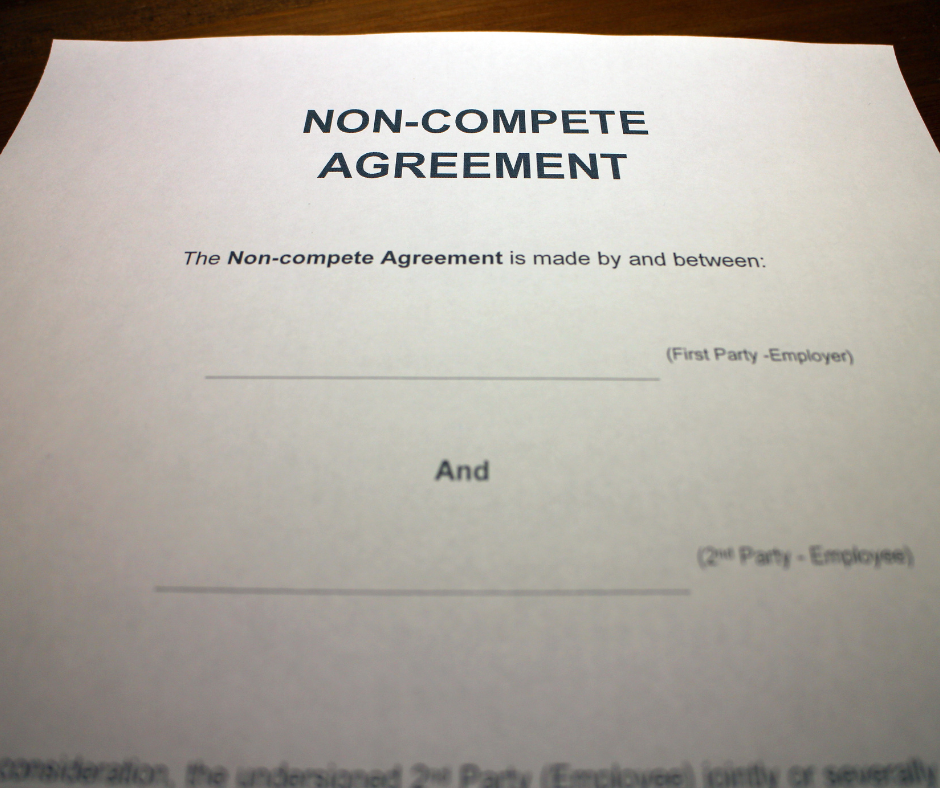
Non-Competes Now a Nonstarter
This is really big news!
Businesses that have entered into non-compete agreements with current or recently departed employees will need to come up with other ways of achieving the investment-protecting goals those non-competes were designed to accomplish. That’s because the Federal Trade Commission has issued a final rule, which will take after 120 days after publication in the Federal Register, that invalidates current non-competes for most workers and bans new ones for all employees.
Don’t Dirty Your Business’ Reputation by ‘AI-Washing’
Many people have become familiar with the term “greenwashing,” referring to attempts by a company to cast its products as more environmentally friendly than they are through public relations and marketing “spin” efforts.
Now comes the concept of “AI-washing,” in which companies exaggerate the degree to which or ways in which their products and services are powered by artificial intelligence, in order to gain a real or perceived competitive advantage. In addition to potentially misleading consumers and harming investors, this can break U.S. securities law, according to Gary Gensler, chair of the Securities and Exchange Commission.
Continue Reading Don’t Dirty Your Business’ Reputation by ‘AI-Washing’
How Can Generative AI Assist Your Business?
What is generative artificial intelligence, embedded in applications such as ChatGPT? How could it help your business? What pitfalls should you avoid. What policies should you craft around it?
This is no longer science fiction. AI has become a reality and every business will be impacted by its use and application and your business must get on board with dealing with it and using it.
Continue Reading How Can Generative AI Assist Your Business?
Real Estate Brokers’ Commissions Upended by Recent Settlement
Decades-old norms regarding Realtor commissions and other policies surrounding home buying and selling have been swept away by the March 15 court settlement between the National Association of Realtors and groups of homeowners who filed suit against the realtors’ group arguing that home buyers should pay their agents’ commissions directly and – most significantly – be able to negotiate that fee.
As a result of the settlement – which is still subject to the approval of the judge overseeing the case – the standard 6% commission on a home sale, heretofore split between the buyers’…
Continue Reading Real Estate Brokers’ Commissions Upended by Recent Settlement