
Cook County property tax bills can be frustrating, especially after a reassessment. But a higher tax bill does not automatically mean your property assessment is wrong.
Before filing an appeal, the better question is:
What is the actual reason the assessment should be reduced?
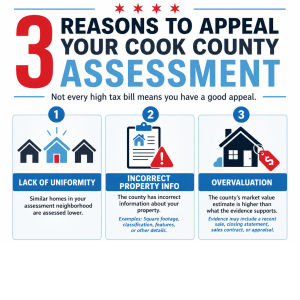
For many Cook County residential property owners, the most common appeal arguments fall into three categories: lack of uniformity, incorrect property characteristics, and overvaluation.
1. Lack of Uniformity
A uniformity appeal argues that your property is assessed higher than similar properties.
This does not mean simply finding a neighbor with a lower tax bill. A useful comparison usually involves properties that are similar in location, classification, building size, land size, age, construction, and other characteristics.
For example, if two similar homes in the same assessment neighborhood have very different assessed values, the higher-assessed owner may have a reason to review whether the assessment is fair.
The key is comparing your property to genuinely similar properties, not just cherry-picking the lowest tax bill on the block.
2. Incorrect Property Characteristics
Sometimes the issue is simpler: the county may have bad information about the property.
Assessment records may include details such as square footage, property classification, land size, building type, construction, or other characteristics. If those details are wrong in a meaningful way, the assessment may be affected.
For example, an incorrect building size or property classification could result in a valuation that does not match the actual property.
In this type of appeal, documentation matters. Photos, property records, surveys, deeds, appraisals, or other supporting evidence may help show that the county’s records should be corrected.
3. Overvaluation
An overvaluation appeal argues that the Assessor’s estimated market value is too high.
This may happen when the county’s value is higher than a recent sale price, higher than comparable market sales, or unsupported by the property’s actual condition.
Evidence may include a recent closing statement, sales contract, appraisal, or comparable sales of similar homes.
This is different from saying, “My taxes are too high.” The question is whether the county’s market value estimate is too high based on actual evidence.
Start With the Right Argument
The biggest mistake many homeowners make is starting with the tax bill instead of the assessment.
A higher tax bill may be caused by several things, including changes in local tax rates, exemptions, levies, or reassessment values. An appeal focuses on whether the assessment itself is wrong.
Before filing, ask:
- Is my property assessed higher than similar properties?
- Are the county’s property details inaccurate?
- Is the county’s market value estimate too high?
If the answer is yes, an appeal may be worth reviewing.
Final Thought
Cook County property tax appeals are evidence-driven. The stronger your reason and documentation, the better positioned you are to challenge an inaccurate assessment.
The first step is not simply being unhappy with the bill. The first step is knowing which argument applies.
The post The 3 Main Reasons to Appeal Your Cook County Property Tax Assessment appeared first on Real estate attorney in Chicago, Illinois.